For years, the path to online visibility was relatively straightforward: consumers searched Google, reviewed a page of results, and clicked through to a website.
Artificial intelligence is changing that journey.
Consumers can now ask AI platforms questions directly, while traditional search engines increasingly provide AI-generated answers before a user ever visits a website. And the shift is no longer limited to early adopters.
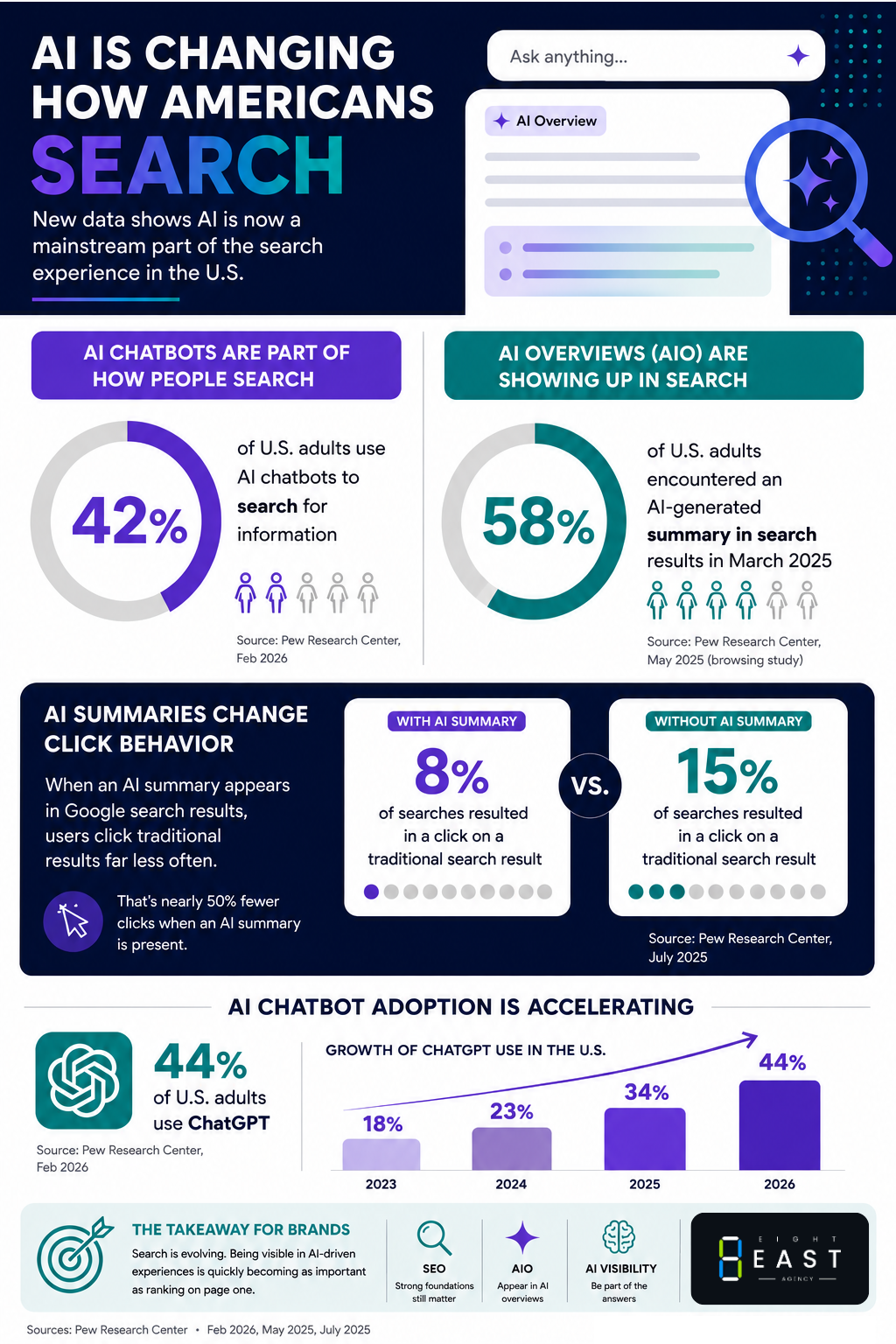
According to 2026 research from Pew Research Center, 42% of U.S. adults say they use AI chatbots to search for information.
For marketers, that raises an important question: if consumers are increasingly getting answers from AI, how visible is your brand within those answers?
AI is becoming part of the search journey
AI chatbots are quickly becoming another way consumers discover and research information.
Pew Research Center surveyed 5,119 U.S. adults in February 2026 and found that 42% use AI chatbots to search for information. Searching for information is now one of the most common reasons Americans report using AI chatbots.
But AI's influence on search goes beyond dedicated platforms like ChatGPT and Gemini. Google is incorporating generative AI directly into the traditional search experience through features like AI Overviews and AI Mode. That means consumers don't necessarily have to abandon Google to experience AI-powered search. AI can become part of the search journey itself.
How many Americans are actually using AI chatbots
- 49% of U.S. adults now use AI chatbots, up from 33% in 2024
- 24% use them daily: 8% about once a day, 12% several times a day, and 4% almost constantly
- 51% still do not use them at all
Put another way: nearly everyone who uses a chatbot uses it to look things up. Search is the dominant use case, not a secondary one.
By platform, share of U.S. adults reporting use:
| Chatbot | Share of U.S. adults |
|---|---|
| ChatGPT | 44% |
| Gemini | 24% |
| Copilot | 17% |
| Meta AI | 14% |
| Grok | 8% |
| Claude | 6% |
| Character.ai | 3% |
AI Overviews are already reaching search users
Two separate Pew Research Center measurements point the same direction.
In its February 2026 survey, 60% of U.S. adults said they read AI summaries at the top of search engine results. Three-in-ten said they do not, and 10% were not sure.
Behavioral data backs up what people report. Pew analyzed the actual browsing behavior of 900 U.S. adults during March 2025 and found that 58% conducted at least one Google search that month which produced an AI-generated summary.
Self-reported use and observed behavior landing two points apart is a strong signal that AI summaries have become a routine part of search.
AI summaries were particularly common for more complex searches. Pew found that only about one in twelve searches containing one or two words generated an AI summary. For searches containing 10 words or more, that figure increased to 53%. Searches framed as questions were even more likely to trigger an AI summary.
This matters because consumers are increasingly able to get explanations, recommendations, and answers directly on the search results page.
AI-generated answers can change click behavior
One of the biggest implications for marketers isn't simply that AI-generated search results exist. It's what happens after users see them.
Pew found that when an AI-generated summary appeared in Google Search, users clicked a traditional search result in 8% of visits. When an AI summary did not appear, users clicked a traditional result in 15% of visits. Users clicked links contained directly within the AI summaries in just 1% of visits.
That doesn't mean organic search traffic is disappearing. But it does illustrate an important shift: visibility and website traffic may no longer be the same thing.
A consumer could discover a brand, learn about a product, or receive an answer influenced by a company's content without following the traditional search-to-website journey marketers have measured for years.
Our perspective at 8 East Agency
Taken together, these statistics point to a bigger change than the arrival of another marketing channel. Search itself is becoming more fragmented and more answer-driven.
For brands, that means strong organic visibility increasingly requires more than pursuing rankings in isolation.
At 8 East Agency, we look at search as an interconnected ecosystem: technical SEO, useful and authoritative content, brand credibility, traditional search visibility, and emerging AI discovery all reinforce one another. The opportunity is to build a digital presence that search engines and AI systems can confidently understand, surface, and reference, while still creating an experience that earns trust with the people behind the query.
From search rankings to answer visibility
Traditional SEO has historically focused heavily on where a website appears in search results. That still matters.
Google's guidance says the fundamentals of SEO continue to apply to its generative AI search experiences. Pages must still be crawlable, indexed, and eligible to appear in Google Search to be considered as supporting links in AI Overviews and AI Mode.
Google's guidance adds one requirement site owners often miss: beyond being indexed and eligible to appear with a snippet, a site must be included in Search generative AI features in Search Console to be eligible for display in those experiences.
But marketers now have an additional layer of visibility to consider. The question isn't only, "Does our website rank?" It's also, "Does our brand appear when AI answers questions about our category?"
This emerging discipline is often described using terms like AIO (AI Optimization), AEO (Answer Engine Optimization), GEO (Generative Engine Optimization), and AI visibility. Terminology is still evolving, and Google considers optimization for its generative AI search experiences an extension of SEO rather than a replacement for SEO.
Regardless of terminology, the strategic objective is becoming clearer: create authoritative, useful information that both people and search systems can understand, trust, and surface when answering relevant questions.
What does AI search mean for SEO?
The emergence of AI search does not mean companies should abandon SEO. It means SEO strategies need to account for a broader search environment.
Google says many practices that help websites succeed in traditional search also apply to AI-powered search experiences: publish original, useful and trustworthy content; make pages accessible to crawlers; build strong internal linking; provide a good page experience; keep important information available as text; use high-quality images and video where appropriate; and ensure structured data accurately reflects visible page content.
Google also emphasizes unique, non-commodity content. Original research, expert commentary, proprietary data, first-hand experience, and case studies can therefore become increasingly important content assets.
What Google says you can skip
Most coverage of AI search is a list of things to start doing. Google's own guidance also includes a list of things you don't need to do, and several are tactics currently being sold as essential.
According to Google Search Central:
You don't need an llms.txt file. Google Search doesn't use llms.txt or similar machine-readable AI files. Google states plainly that creating one will neither help nor harm your visibility or rankings in Google Search. It may still be worth maintaining for other systems that do read it, but not for Google.
You don't need to "chunk" your content. There's no requirement to break pages into small pieces for AI to understand them. Google says its systems can handle multiple topics on a single page and surface the relevant portion. There is no ideal page length.
You don't need to rewrite content specifically for AI. AI systems understand synonyms and intent, so you don't need to capture every long-tail variation of how someone might phrase a question.
Chasing "mentions" isn't the shortcut it looks like. Google specifically warns against seeking inauthentic mentions across the web. Its core ranking systems focus on high-quality content while separate systems filter spam, and its generative AI features depend on both.
Structured data isn't required for AI search. There's no special schema.org markup that makes content eligible for generative AI features. Structured data is still worth using as part of an overall SEO strategy, because it supports rich results in traditional search, just not as an AI-specific tactic.
Google also flags a spam risk worth knowing about: generating separate pages for every possible query variation, purely to influence rankings or AI responses, falls under its scaled content abuse policy.
The through-line is consistent with everything else in Google's guidance. There is no AI-specific hack. There is good content, sound technical structure, and patience.
How brands can prepare for AI-driven search
1. Understand the questions customers actually ask. Think beyond short keywords and identify the actual questions customers ask during research and purchasing decisions.
2. Create content that provides clear answers. Use descriptive headings, concise explanations, supporting evidence, and logical page structures.
3. Build topical authority. Develop interconnected content around topics your organization genuinely understands and wants to be known for.
4. Add information AI can't easily reproduce. Original data, customer insights, expert opinions, research, case studies, and first-hand experience provide differentiation.
5. Keep your brand information consistent everywhere it appears. Accurate, consistent details across reputable publications, industry resources, and directories contribute to a clearer digital footprint. Note the distinction Google draws here: earning genuine coverage is worthwhile, while manufacturing mentions for their own sake is not.
6. Continue investing in technical SEO. Content still needs to be accessible, crawlable, and understandable to search engines.
7. Measure more than rankings. Track rankings and organic traffic alongside AI citations, brand mentions in generated answers, and AI referral traffic. Google Search Console now includes a Generative AI performance report showing how content performs in generative AI features across Google Search and Discover. Google also cautions against third-party tools claiming access to internal ranking or AI systems: no third-party tool has it.
Key takeaways
- 42% of U.S. adults use AI chatbots to search. AI is now a mainstream part of the search journey, not an edge case.
- 60% of U.S. adults read AI summaries in search results. AI is showing up inside traditional search, not just outside of it (Pew, February 2026).
- AI summaries cut click-through nearly in half. 8% click a traditional result when an AI summary appears, versus 15% when it doesn't (Pew browsing study, March 2025).
- SEO fundamentals still apply. Google explicitly says its AI features rely on the same crawlability, indexing, and content quality signals.
- Visibility now means being part of the answer. The goal isn't just to rank. It's to be trusted, cited, and surfaced across AI-powered experiences.
- Google publishes a "don't bother" list too. No llms.txt, no content chunking, no AI-specific rewriting, no schema requirement. Be skeptical of anyone selling those as necessary.
The future of search is becoming answer-driven
The shift from traditional search to AI-assisted discovery isn't happening overnight. Consumers still use traditional search engines. Websites still matter. And SEO still matters.
What's changing is how and where consumers find answers.
A potential customer might click a traditional search result. They might get what they need from a Google AI Overview. They might continue their research in AI Mode. Or they may bypass traditional search altogether and ask an AI platform directly.
For brands, that creates a new visibility challenge, and a significant opportunity.
At 8 East Agency, we believe the brands that adapt successfully won't be the ones that abandon SEO for the latest AI trend. They'll be the ones that build an integrated search strategy: combining strong SEO fundamentals with authoritative content, technical performance, and an understanding of how brands are being discovered across AI-powered experiences.
The goal is no longer simply to rank. It's to become a trusted, discoverable source wherever your customers are searching for answers.